

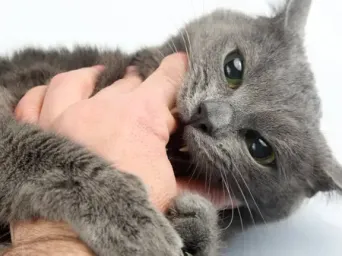
Feline aggression can be explained. No, your cat isn’t “mad”, “nasty”, “vicious”…
A cat that attacks rarely does so for nothing. There are several factors, which can sometimes add up: pain, stress, frustration, predation, lack of physical or mental stimulation, an unsuitable environment or (often) a misreading of their signals… Aggression is a reaction that stems from an emotion, not a fixed personality trait.
Sometimes the attack happens when the cat feels their body or their space is being invaded, or when they can no longer express their natural needs. Often, the signals of irritation or unease are misread or ignored. This is not “revenge” but a real defence mechanism, used as a last resort. A small everyday example: the cat settles on the sofa, and their human strokes them because “they came over by themselves, so they must want cuddles!” The subtle signs creep in: tail starting to move gently, ears slightly back, back tensing, a fixed gaze… And boom! The cat bites “for no reason”, and the human cries “but they’re mad! They came to me!”…
The causes to dig into
- Pain or physical illness: A cat in pain may react violently to the slightest touch. Before considering a behavioural cause, always see your vet.
- Stress and fear: A change of environment, a new human, an unusual noise… sometimes that is all it takes to trigger “full-on angry ninja mode”.
- Frustration and lack of stimulation: Boredom is the enemy. An environment that is too bare, few games, no exploring… often ends in an ambush behind the sofa.
- Predation: Another factor, often underestimated: the cat is a predator, and sometimes our movements can trigger a predatory behaviour sequence… on us. And that’s a no! That is why it is better to offer them substitute prey, feather wands, toy mice, balls, rather than their human’s hand!
- Human misinterpretation: Insisting on reading a cat’s signals through a human lens, wanting cuddles at all costs, or overlooking their non-verbal language… this leads to misunderstanding (and sometimes to a nasty bite or scratch on the arm).
- Human emotions mirrored: Your cat “senses” when you are tense, defensive or frightened. For example, if there has already been an attack, it is no surprise that you don’t feel at ease or confident with your little feline demon. This climate of uncertainty and unease can trigger or heighten their own tension, creating a vicious circle: Kitty attacked once for reason x or y, their human becomes wary, Kitty thinks “I’m right to be on my guard, something is clearly wrong, they’re acting weird”, and the result is that everyone is on edge.
- The payoff behind the aggression: Yes, even when it is negative, being told off or getting attention (gestures, words, a look) after an attack can reinforce the behaviour. The cat understands that “every behaviour gets a reaction”. The real vicious circle? Every time they attack, even if the human reaction is negative (shouting, gestures…), the cat still gets what they are after: an interaction. Here, for them, any reaction may well be better than indifference. To get out of this endless loop, the key is to ignore the cat completely when they attack (easier said than done, I hear you say! And you’d be quite right… but the fact is, it is something to take into account. So off we go, gearing up… We put on 3 pairs of trousers, mittens, a puffer jacket and 5 pairs of socks, and we hold out, move away or calmly withdraw). Ideally, you anticipate, read the signals, stay calm, and steer the cat’s energy towards another activity so they can let off steam.
Learning to read your cat
The “universal” signals matter: ears back, dilated pupils, moving tail, tense body, hissing, growling… It is important to learn cats’ communication signals in general, but not only that: above all, learn to read your own cat. You live together, so you are the best detective to decode their subtle communication or unique habits. Sometimes your cat may invent their own body language just for you… so keep your eyes open and decode what you see.
Mistakes to avoid
- Punishing: It is pointless… and very often it even makes everything harder. It can increase tension or stress in Kitty, and so can even make the situation worse by reinforcing and intensifying the aggressive behaviour.
- Looking for “dominance” or a power struggle: Unless you want to test your new bite-proof plaster, forget it. Cats don’t live like that: hierarchy and dominance don’t exist in cats, so if you do this, you are not speaking the same language.
- Neglecting enrichment: If your cat spends their days doing nothing and being bored, a plan B will have to be found. In that case, it is better to give them alternatives proactively, and ways to let off steam, rather than waiting for them to find their own way to let off steam… on you. Cat trees, feather toys, hiding places, puzzle toys, scratching posts… are your best friends.
- Seeing everything through a human lens: Consent exists for whiskered friends too. A cat (even a far too cuuute one) is not a cuddly toy. Let’s respect their bodily boundaries.
Caring for the relationship: taking concrete action
- Enrich their environment (toys, hiding places, circuits, cat trees and rituals).
- Increase interactive play with you, at least 10 to 15 minutes twice a day. Put yourself in their paws: especially if they live indoors, their days are not always very exciting.
- Respect your cat’s moments of withdrawal or indifference, and watch for their specific signals.
- Reflect on your own emotional state and how it influences the dynamic in your relationship with Kitty.
A telling example, from a real consultation: Marion, tired of Merlin’s “chomping” sessions, turned her living room into a vertical playground: shelves at different heights, walkways, a lookout spot on top of a wardrobe… and a few other complementary strategies. Within a week, far fewer attacks, more stimulation, a calmer cat… and a human who can finally enjoy her Netflix evenings without losing a toe.
Every human-cat duo is unique! The analysis needs to be personalised, and tailored support may be needed in these situations, which are often complex and emotionally hard to live with. No need to face it alone.
When should you see a behaviourist?
When the spiral sets in or the advice above does not bring a lasting solution, a behaviour consultation makes it possible to:
- Learn to read your cat preventively and avoid ending up in a dynamic that is already too entrenched.
- Observe the family and the cat in their environment.
- Analyse the dynamic, the routines and the emotions in the home.
- Offer concrete strategies, always based on consent and respect for both cat and human!
- Restore trust and calm.
Conclusion: rebuilding trust, step by step
Aggression in cats is not inevitable: it is a message. It is neither nastiness nor an unchangeable personality trait. It is an opportunity: to observe, to learn to decode and to rebuild trust. Ask yourself every day: have I really understood their language, respected their limits and enriched their daily life? And what do they gain from this behaviour? With a little perspective and a few adjustments, a damaged bond can become a calm and respectful relationship, for the good of cats and their humans.
Any questions? Feel free to contact me. Together, we can explore what your cat is communicating and find the right solutions.
Important note: This article presents the most common causes of aggression by cats towards humans, based on my knowledge, my reading and my professional experience. It is by no means an exhaustive list. Every cat is unique, and the reasons for their behaviour may be multiple, complex or different from those mentioned here. Sometimes a combination of factors may be involved, and in some cases medical treatment may be needed.
It is important to note that an animal behaviour consultation never replaces a veterinary consultation. It is essential to see a vet first to rule out any medical cause that could explain or contribute to your companion’s aggressive behaviour.
Sources
- Veterinary thesis, “Les comportements agressifs chez le chat”: https://theses.vet-alfort.fr/telecharger.php?id=829
- CEEPHAO, L’agressivité chez le chat: https://ceephao.com/agressivite-chez-le-chat/
*- Felikat, Pourquoi mon chat m’attaque ? https://www.felikat.org/pourquoi-est-ce-que-mon-chat-mattaque/
- Styllacare, Pourquoi mon chat m’attaque soudainement ? https://styllacare.com/fr/blogs/chat/pourquoi-mon-chat-m-attaque-soudainement*
- Le Point Vétérinaire, Les agressions chez le chat: https://www.lepointveterinaire.fr/publications/le-point-veterinaire/article/n-424/etape-8-les-agressions-chez-le-chat.html
- Animalis, Stimuler votre chat: https://www.animalis.com/conseils/chats/nutrition-chat-chaton/stimuler-votre-chat-le-jeu-comme-cle-de-son-bien-etre/

It all starts with getting to know each other.